
How to Search Wayne County Court Records
Finding a Wayne County court record starts with the type of case, not a single website. The county splits its trial work among Circuit Court, Chancery Court, Justice Court, and two municipal courts. Each one keeps its own files. A felony or a large civil suit lives with the Circuit Clerk. A divorce, an estate, or a land deed lives with the Chancery Clerk. A rural speeding ticket or a small debt claim sits with Justice Court. Match the record to the court first, then pick the channel that court uses.
Before you start, gather the full legal name of a party, a date range, and a case or citation number if you have one. Statewide case files run through Mississippi Electronic Courts, known as MEC, with public access through the PAMEC login. Land and instrument records run through the county Chancery portal. When an online search comes up empty, the clerk counter and the phone line still work. The Wayne County government site links most of these offices in one place.
The county homepage gathers court contacts, forms, and online services that point to the right office. You can open the official Wayne County website to reach the courts, clerks, and sheriff pages from a single hub.

That hub is useful because Wayne County does not run one combined case search. The links route you to the Circuit Clerk, the Chancery Clerk, the sheriff, and the traffic and marriage pages, each holding a different slice of the record.
- Decide the record type: criminal, civil, family, probate, land, traffic, or juvenile.
- Match it to the court that made it, then note that court's clerk.
- For Circuit or Chancery case files, register and log in at the PAMEC public access portal.
- For land or estate instruments, open the Wayne Chancery records inquiry and search by name or property data.
- If no record shows online, call or visit the clerk with names, a date range, and any case number.
The Wayne County Judicial System
Mississippi divides trial courts by subject, and Wayne County follows that pattern. Circuit Court is the general trial court for felony prosecutions, civil suits over $200, and appeals from the lower courts. Chancery Court is the equity and family court for divorce, custody, estates, guardianships, land title, and commitments. Justice Court handles small civil claims up to $3,500, misdemeanors, and traffic outside city limits. Municipal courts in Waynesboro and State Line take city citations and ordinance cases. Youth Court hears juvenile matters, and its files are sealed.
Wayne County sits in the 10th Circuit Court District with Clarke, Lauderdale, and Kemper counties. Its Chancery work falls in the 19th Chancery District, shared with Jones County. Appeals from these trial courts go to the Mississippi Supreme Court or the Mississippi Court of Appeals by assignment. The state judiciary site explains how each court level fits together.
The county court page lists every local court with its judges, address, and phone number in one view. You can review the Wayne County courts page to confirm current officials before you call.
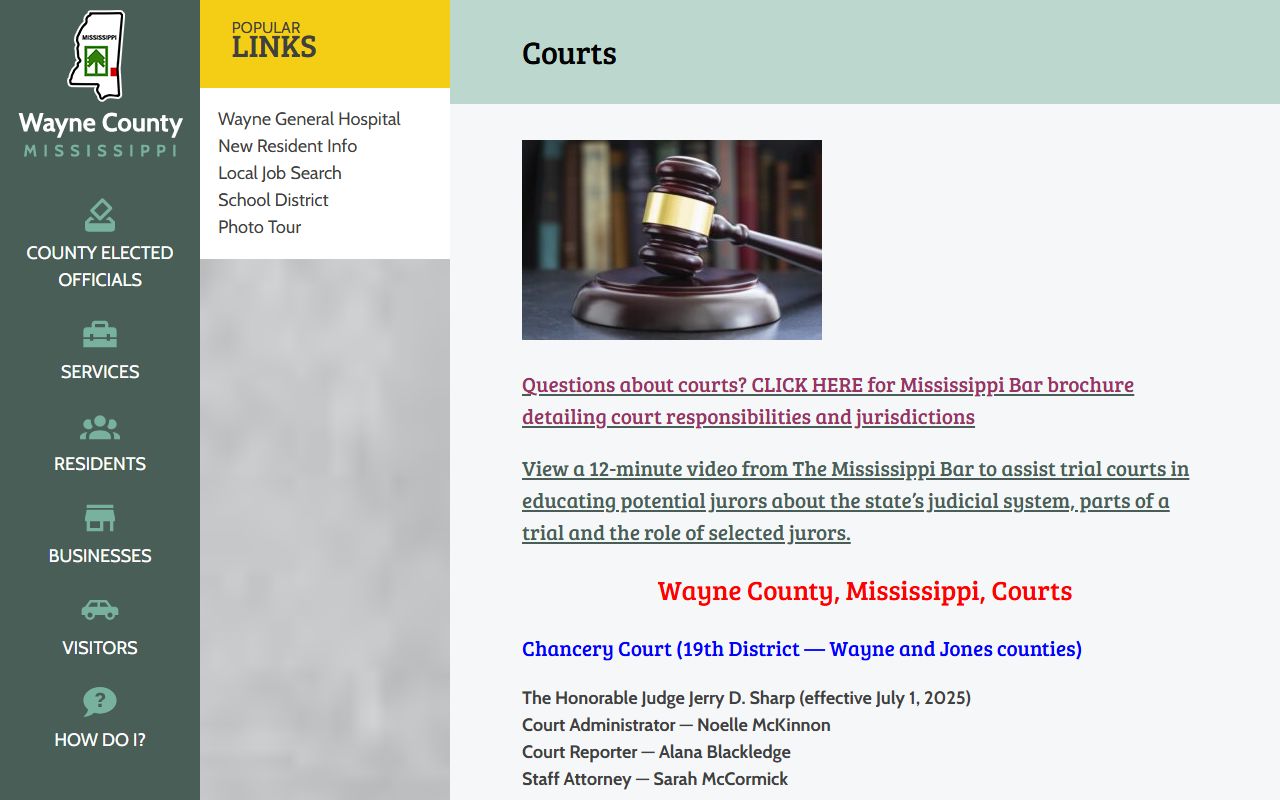
That page is the most reliable source for who holds each seat, since terms and contacts change between elections. The table below maps the main court levels to what they hear.
Case flow: Justice Court › Circuit Court › Mississippi Court of Appeals › Mississippi Supreme Court
| Court | Jurisdiction | Case Types |
|---|---|---|
| Circuit Court | 10th Circuit District | Felonies, civil suits over $200, appeals, warrants |
| Chancery Court | 19th Chancery District | Divorce, custody, estates, land title, commitments |
| Justice Court | Countywide, outside city limits | Claims up to $3,500, misdemeanors, rural traffic |
| Municipal Court | Waynesboro and State Line limits | City citations and ordinance violations |
| Youth Court | Countywide juveniles under 18 | Delinquency, abuse or neglect, sealed files |
Where Wayne County Court Records Are Kept
Wayne County uses a split clerk system, and that fact trips up many searches. The Circuit Clerk and the Chancery Clerk are two separate elected officers with two separate sets of records. Kathryn "K.K." Revette serves as Circuit Clerk for the 2024 to 2028 term. Her office keeps the general court docket, criminal and civil case files, the subpoena and execution dockets, marriage licenses, voter rolls, and jury records. She also acts as the county voter registrar. The Circuit Clerk's office sits on the first floor of the courthouse near the South entrance.
The Circuit Clerk page confirms the office address, phone, fax, and email along with the clerk's statutory duties. You can open the Wayne County Circuit Clerk page to verify those contact details before a visit.
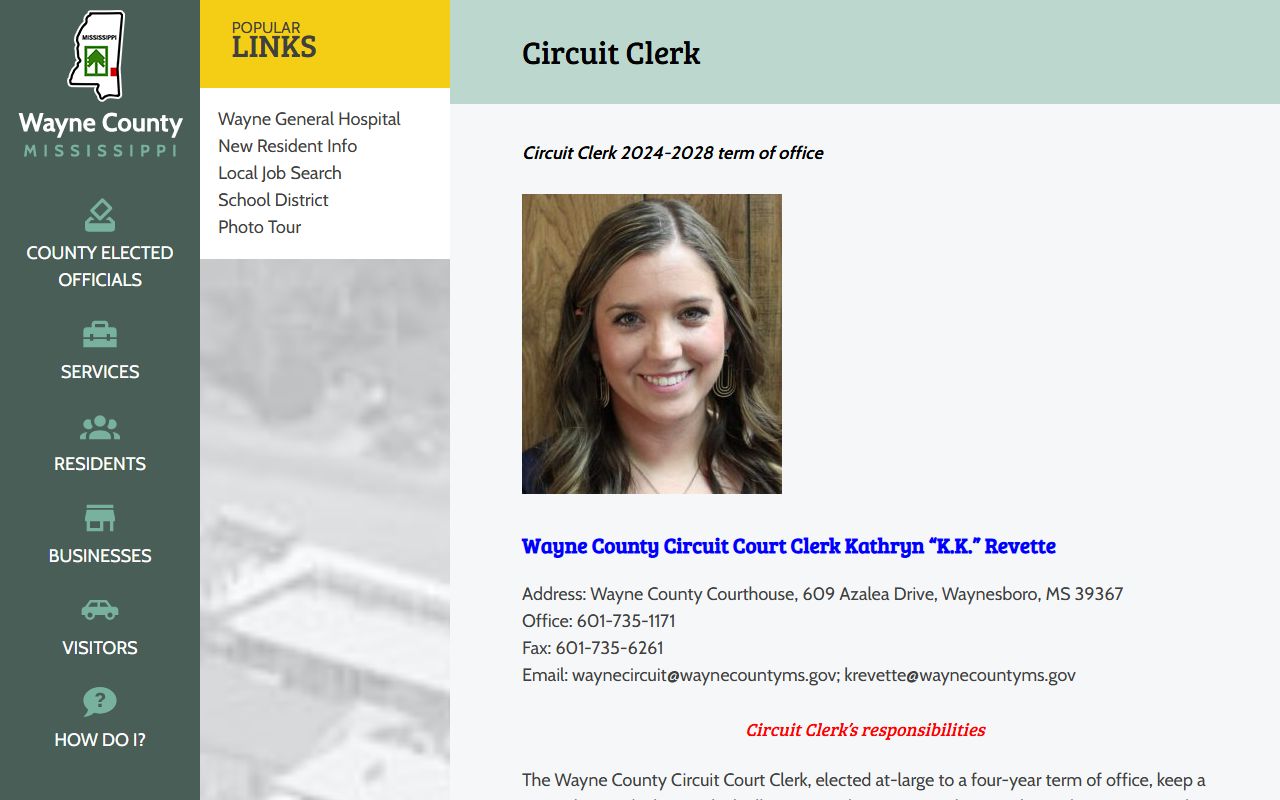
That page matters because the Circuit Clerk does not hold divorce, estate, or land records. Those belong to the Chancery Clerk, William Jeremy Carr, who serves the same 2024 to 2028 term. The Chancery Clerk records deeds of trust, mortgages, mineral leases, and land plats, keeps the Chancery Court minute books, and serves the Board of Supervisors. He also maintains county accounting books and the docket of claims. A person searching for a deed or a will should start with the Chancery Clerk, not the Circuit Clerk.
Both clerks share the same building at 609 Azalea Drive in Waynesboro. The county states that Chancery Clerk records and papers are open to inspection by citizens, and the clerk or a deputy should show requesters where records are kept or make a copy on request.
Searching Wayne County Chancery Land Records
Land and instrument records have their own online tool, separate from court case files. The Wayne County Chancery official records inquiry, built on the DuProcess platform, lets anyone search deeds, mortgages, liens, and plats for free. The first scanned page of a document is viewable at no charge. Later pages must be purchased before you can view, print, or download them. The portal supports name searches in grantor and grantee directions and also accepts property data such as book and page, instrument number, legal description, parcel ID, and subdivision.
A researcher who knows the property details has better odds than a name-only search. You can open the Wayne Chancery records inquiry portal and accept the terms of use to begin.
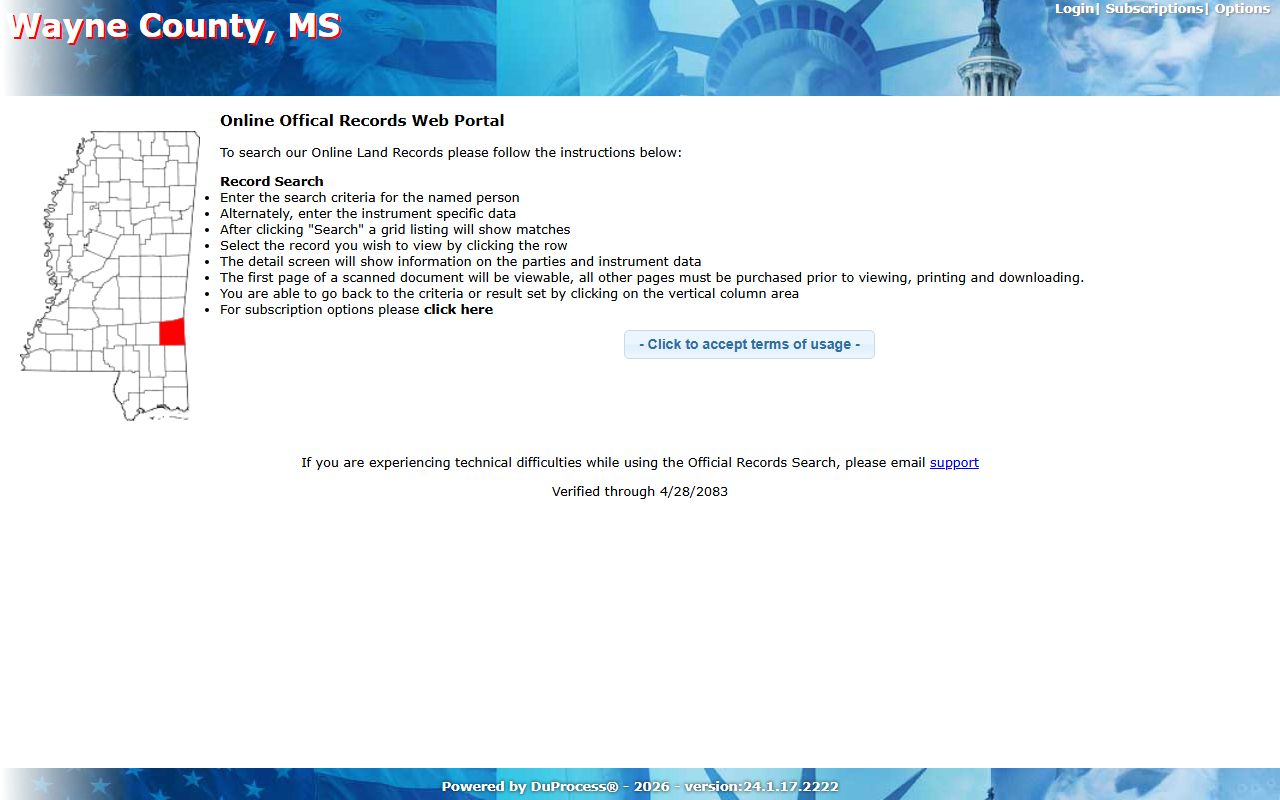
The portal is not a criminal or civil case search. It is an official records system for land and recorded instruments. The search fields below come straight from the portal layout.
| Field Label | Type | Notes |
|---|---|---|
| Search All / Grantee / Grantor | Radio | Search All is the default name direction |
| Full Name | Text | Format as lastname, firstname |
| Begin Date / End Date | Date | Range starts as early as 1/1/1800 |
| Recently Filed | Radio | Last 7, 30, or 90 days |
| Instrument Type | Multi-select | Default is All Types |
| Book / Page / Instrument # | Text | Use for a known recording reference |
| Parcel ID / Legal Desc. | Text | Best for property-specific searches |
Note: The first scanned page is free to view, but Wayne County requires payment for any remaining pages before they can be opened, printed, or saved.
Types of Court Records Available in Wayne County
The county produces a wide range of records because each court keeps a different kind of file. Circuit Court generates felony case files and large civil suits. Chancery Court generates family, estate, and land records. Justice Court and the city courts generate misdemeanor, traffic, and small civil files. Knowing which record lives where saves a wasted trip to the wrong clerk.
Most of these records are open to the public, though some carry redactions or seals. The list below sorts the common record types by the court that holds them.
- Criminal records - Felony files at Circuit Court; misdemeanors at Justice or municipal courts.
- Civil records - Suits over $200 at Circuit Court; claims up to $3,500 at Justice Court.
- Family and divorce records - Divorce, custody, and support at Chancery Court.
- Probate records - Wills, estates, and guardianships at Chancery Court.
- Land records - Deeds, mortgages, and plats at the Chancery Clerk.
- Traffic records - Split among Justice Court, Waynesboro, and State Line by where the ticket was written.
What Wayne County Court Records Show
A court record is a chronological account of a case from filing to final order. The exact fields depend on the court and the case type, but most files share a common core. Circuit and Chancery case files carry a case number, the parties, the assigned judge or chancellor, and a docket of every filing and hearing. Land records carry party names in grantor and grantee direction, a recording date, a book and page, and an instrument type.
A criminal file may add the charge, the bond, the plea, the verdict, and the sentence. A civil file may add the complaint, the answer, motions, and the judgment. The table below shows the fields a typical case record displays.
| Field | What It Shows |
|---|---|
| Case Number | The clerk's index for the file, used to pull every related filing |
| Filing Date | When the complaint, indictment, petition, or instrument was filed |
| Parties | Plaintiff and defendant, state and defendant, or grantor and grantee |
| Charges / Cause | The offense charged or the legal basis for a civil or equity claim |
| Disposition | The case outcome, such as a plea, verdict, dismissal, or final decree |
| Sentence / Judgment | The punishment or the court's final ruling on rights and liability |
Public Access Laws for Wayne County Court Records
Mississippi treats public records as open unless another law closes them. The Public Records Act lives in Title 25, Chapter 61 of the Mississippi Code. It sets the policy that records held by public bodies are open for inspection, gives the public a response deadline, and limits what an office can charge. Wayne County clerks operate under these rules, though sealed court orders, juvenile files, and adoption records sit outside the Act.
The Mississippi Ethics Commission publishes a plain summary of the Act and hears complaints when a request is denied. The key statutes appear below with a short plain-English note for each.
Key Statutes:
Miss. Code § 25-61-1 - Sets the policy that public records are open for inspection unless another law says otherwise.
Miss. Code § 25-61-3 - Defines what counts as a public record held by a public body.
Miss. Code § 25-61-5 - Requires a response within seven working days, with a written reason for any delay.
Miss. Code § 25-61-7 - Lets an office charge only the actual cost of searching, copying, and mailing.
Miss. Code § 25-61-13 - Routes denied requests to the Ethics Commission for review and enforcement.
Miss. Code § 25-61-15 - Sets penalties for a wrongful denial or an unreasonable fee.
The Mississippi Ethics Commission Public Records Act page is the place to confirm the current text and the complaint process. Note: Sealed court records require a judge's order to open, so the Public Records Act alone will not unlock them.
Records That Are Restricted or Confidential
Open-records law does not reach every file. Wayne County Youth Court is closed to the media and the public, and its records are sealed under state law. Juvenile delinquency records may be sealed when the youth reaches a set age or when a case is set aside. Adoption files held in Chancery Court are not ordinary public records. Mental-health and substance-abuse commitment files are restricted and reach only the people the court allows.
Expunged and sealed criminal records also drop out of public view. A person seeking an expungement files in the court that handled the case, gathers the arrest date, charge, case number, and disposition, and pays any filing fee. A judge may hold a hearing. Mississippi blocks many serious offenses from expungement, so eligibility is never automatic. Social Security numbers, financial account data, and information that identifies a minor are redacted across record types.
Wayne County Sheriff and Jail Information
Sheriff Jerry "Juice" Mosley leads the office for the 2024 to 2028 term. The Sheriff's Office and Adult Detention Center share the Marvin Farrior Law Enforcement Complex at 613 Court Street in Waynesboro. The jail opened in January 2001 and holds 118 beds across dorms, an isolation area, a receiving area, a control room, a kitchen, a visiting room, and a courtroom. It houses people charged with both felonies and misdemeanors and is inspected by state and federal agencies.
Wayne County does not publish an online jail roster. No official county or sheriff inmate-lookup tool turned up in research, so the reliable channels are the phone line and an in-person visit. For sentenced state prisoners, the Mississippi Department of Corrections runs a statewide search. For custody alerts, the Mississippi VINE service sends notifications. The sheriff page lists the complex address, the administration line, and the emergency number.
You can open the Wayne County sheriff page to reach Sheriff Mosley's office and confirm the current contact numbers.

Because there is no roster online, the jail's published facts stop at the building and its capacity. The full booking and contact detail lives on the Wayne County inmate records page, and active warrant routes appear on the warrant records page.
Marriage, Divorce, and Probate Records
Marriage, divorce, and probate records split across the two clerks. The Circuit Clerk issues marriage licenses from the first floor of the courthouse near the South entrance. Both parties must appear together with valid identification that shows a date of birth in English. Divorce cases, by contrast, are Chancery Court records because Chancery handles all domestic and family matters. Probate of wills and estates also belongs in Chancery Court, along with guardianships and conservatorships.
The Chancery Clerk page describes the chancery records, land records, and minute books the office keeps. You can open the Wayne County Chancery Clerk page to reach the office that holds divorce and estate files.
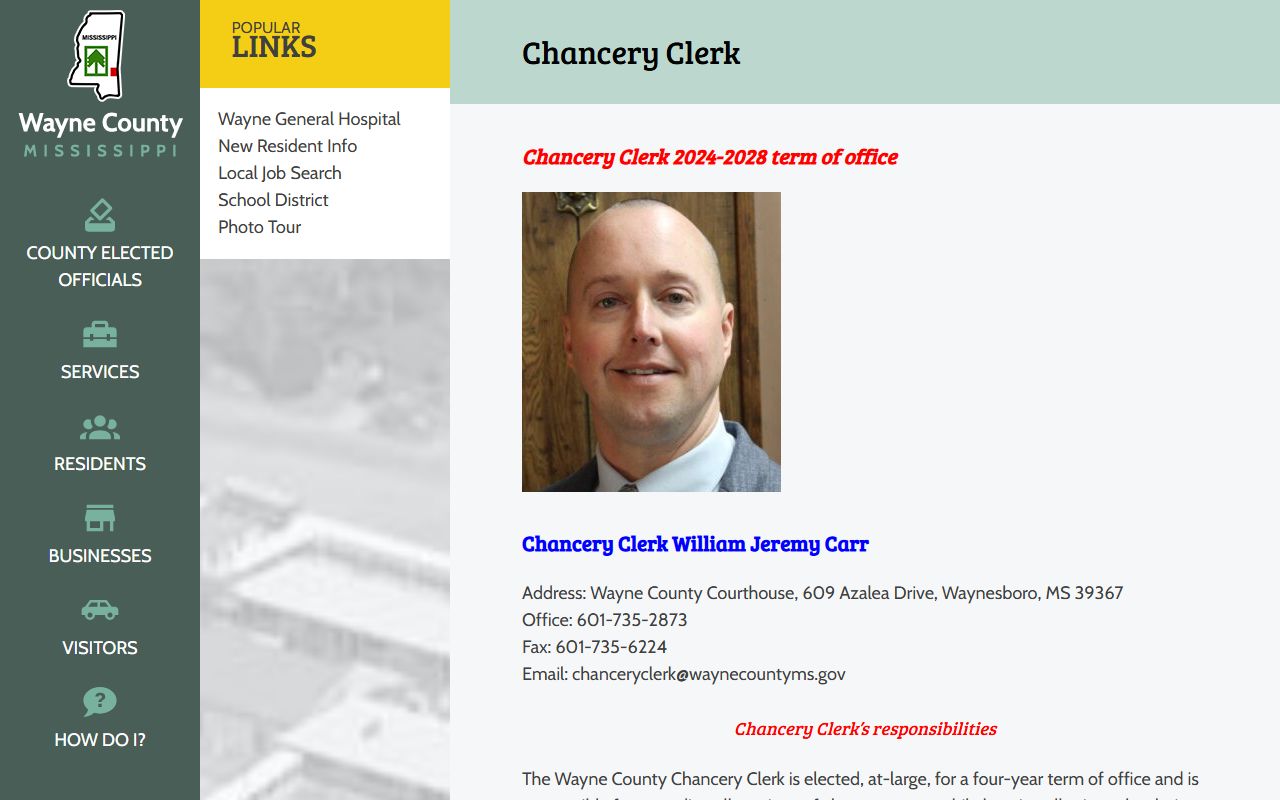
That office is the right stop for a divorce decree or an estate file. Full detail on licenses and decrees lives on the marriage and divorce records page, and estate filings appear on the probate records page. A few probate terms come up often.
- Testator
- A person who makes a will to direct how their estate is handled.
- Executor
- The person named in a will to carry out its terms and settle the estate.
- Intestate
- Dying without a valid will, so state law decides who inherits.
- Conservator
- A person the court appoints to manage the affairs of someone who cannot.
Wayne County Court Records Fees
Wayne County does not post most of its clerk and copy fees online. The official county pages name the filing fees a marriage license or a court case may carry, but they rarely list a dollar amount. Because of that gap, the safest path is to call the clerk for a current quote. State law still governs the ceiling on what an office may charge.
Under Miss. Code § 25-61-7, a public office may bill only the actual cost of searching, copying, and mailing a record. The one fixed amount in the official sources is the marriage statistical record fee. The table below reflects what the county actually publishes.
| Item | Amount |
|---|---|
| Marriage statistical record to Board of Health | $1 |
| Marriage license filing fee | Not posted; call the Circuit Clerk |
| Certified copy from a clerk | Not posted; actual cost under § 25-61-7 |
| Chancery land record image pages | First page free; later pages purchased |
| Public records search and copying | Actual cost under § 25-61-7 |
Note: Do not assume a fee from another Mississippi county applies here, since Wayne County sets and quotes its own amounts at the counter.
Electronic Filing and Recent Access Changes
Court records access in Wayne County changed quickly in 2025. Mississippi Electronic Courts, the statewide MEC system, now carries Circuit and Chancery case files. Attorneys file electronically, and the public reaches docket information through the PAMEC login after registering. Wayne County Chancery Court joined voluntary e-filing back in April 2015, which gives chancery cases a longer digital history than circuit cases. Wayne County Circuit Court began voluntary attorney e-filing on April 29, 2025 and mandatory e-filing on May 5, 2025.
On July 2, 2025, the state judiciary announced that electronic filing was complete across all 188 Chancery, Circuit, and County Courts plus both appellate courts. That milestone means a Wayne County case may now sit in the central system even when the local clerk counter remains the place for certified copies. The MEC landing page explains how the system works and how the public registers.
You can open the Mississippi Electronic Courts page to read the county implementation notes and reach the help desk.
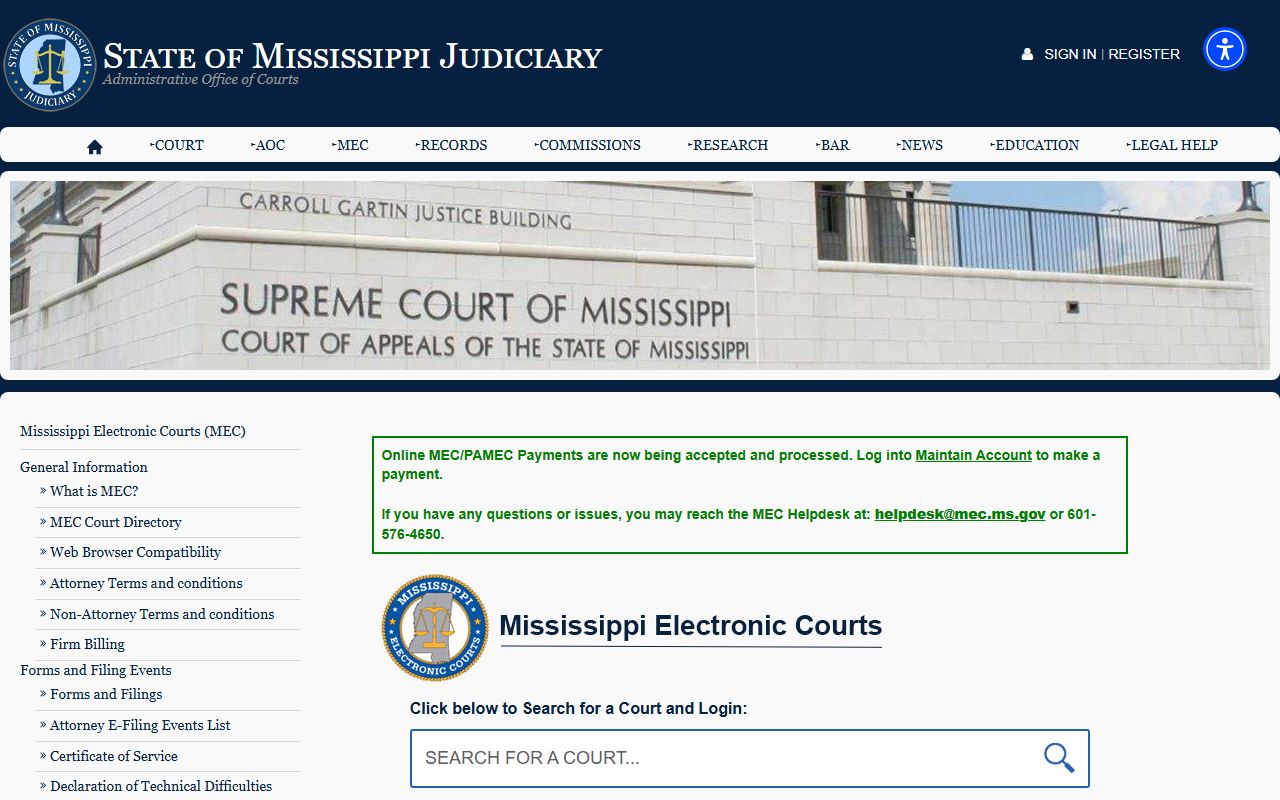
One login on that system lets the public view docket information, download documents, and pull case data in participating courts. Public access runs through PAMEC, where a username and password unlock the records.
You can open the PAMEC registration and login page to set up an account before searching.
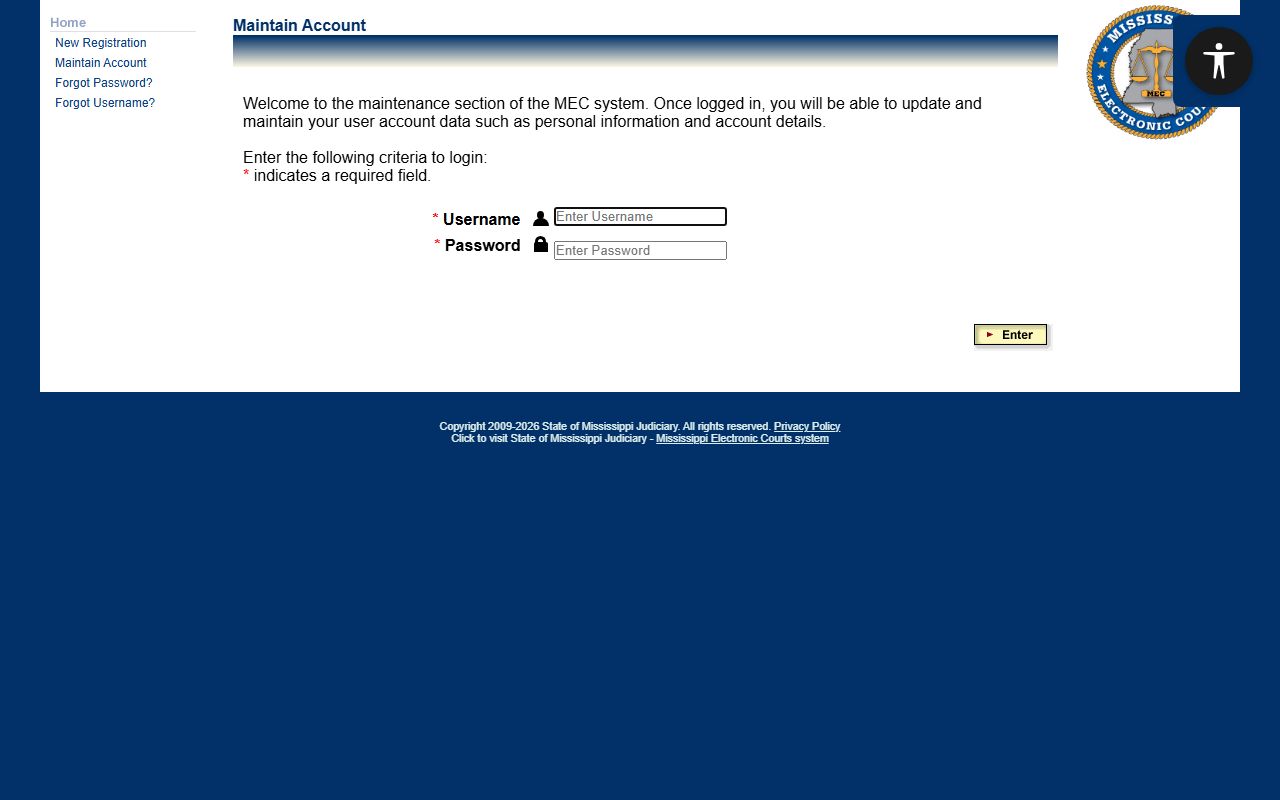
Registration is the gate to electronic case documents, and per-page fees may apply once you open a file. The statewide judiciary homepage ties together MEC, trial courts, and appellate resources.
You can open the Mississippi Judiciary homepage for the official gateway to all of these tools.
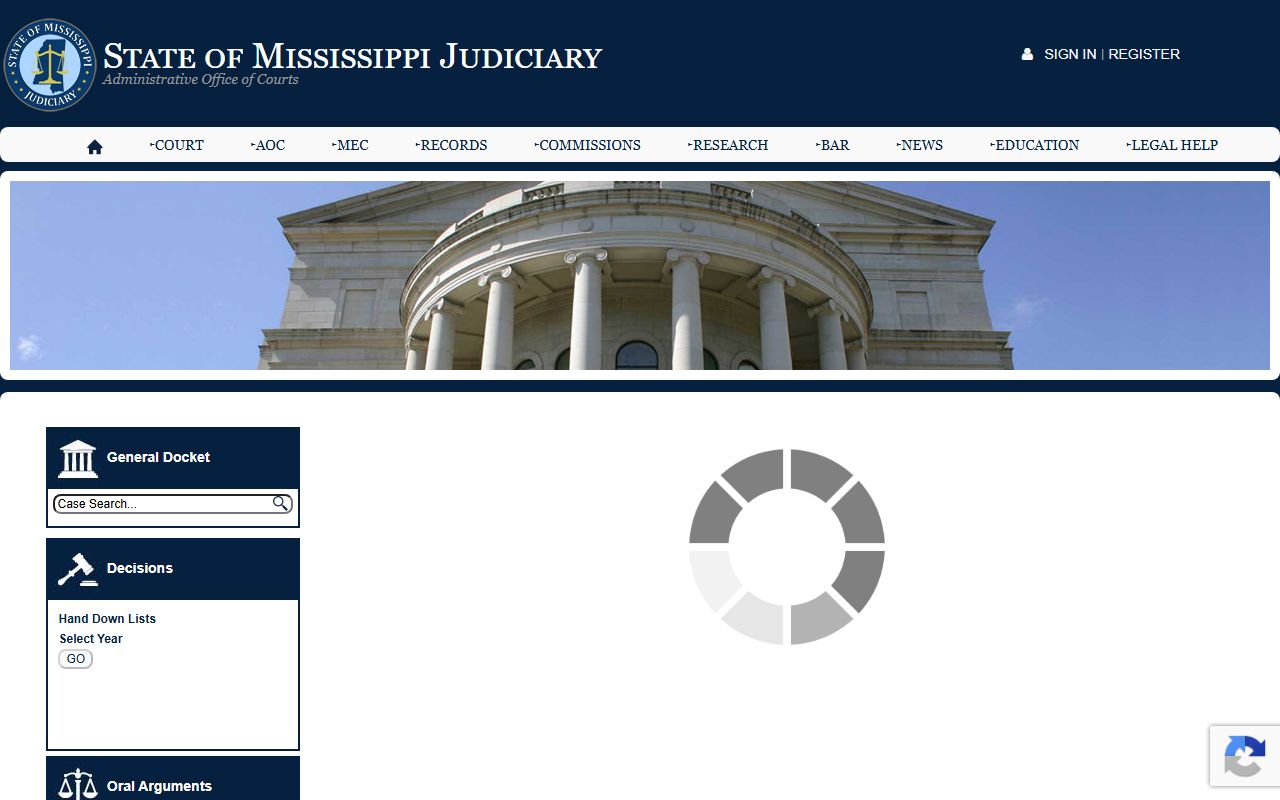
That homepage is the anchor for rules, directories, and court structure when a Wayne County search needs a statewide reference point.
Wayne County Courthouse Location and Contact
The Wayne County Courthouse at 609 Azalea Drive in Waynesboro is the hub for Circuit Court, Chancery Court, Youth Court, and both clerks. The Circuit Clerk sits on the first floor near the South entrance, open 8 a.m. to 5 p.m. Monday through Friday. Justice Court moved to a separate building on the courthouse square at 814 Chickasawhay Street, which opened in September 2023 at more than 7,000 square feet. The sheriff and jail sit a short distance away on Court Street.
The contact card below covers the main courthouse. Confirm parking, security, and recording-device rules directly with the clerk or court before you arrive, since the county does not post those details.
Wayne County Courthouse
609 Azalea Drive
Waynesboro, MS 39367
Circuit Clerk 601-735-1171
Chancery Clerk 601-735-2873
History of Wayne County Courts
Wayne County is older than the state it sits in. The county dates to 1809, eight years before Mississippi reached statehood in 1817, so its court and land-record history reaches into the territorial period. Waynesboro is the county seat. That long history shows in the old split between law and equity, which still shapes where records live today. Divorce, probate, and land files sit with Chancery Court, not the Circuit Clerk, even though many people search for "court records" as one thing.
Recent milestones are mostly about technology and buildings. The sheriff's complex with its 118-bed jail opened in January 2001. Chancery Court began voluntary e-filing in 2015. The new Justice Court building opened in 2023, and Circuit Court joined mandatory e-filing in 2025. Each step pushed Wayne County records further toward a single statewide electronic system while the local clerk counters stayed in place.
Frequently Asked Questions
Where do I search Wayne County court records online?
Circuit and Chancery case files run through the statewide MEC system, with public access through the PAMEC login after you register. Land and recorded instruments run through the separate Wayne Chancery records inquiry portal. There is no single combined county case search, so match the record to its court first. When nothing shows online, the clerk counter and phone line remain the fallback.
Why are there two clerks in Wayne County?
Mississippi splits trial work between law and equity, so the county elects two clerks. The Circuit Clerk keeps criminal, civil, and marriage records and runs voter registration. The Chancery Clerk keeps divorce, estate, and land records, the court minute books, and county accounting. Both work from the same courthouse at 609 Azalea Drive, but they hold different files, so the right clerk depends on the record you need.
Does Wayne County have an online jail roster?
No official online jail roster was found for Wayne County. To check on someone in custody, call the Adult Detention Center on the sheriff's administration line or visit the complex on Court Street. For sentenced state inmates, use the Mississippi Department of Corrections search. For custody alerts, register with the Mississippi VINE service. Bond and court dates should be confirmed with the court of jurisdiction.
Where do I handle a traffic ticket in Wayne County?
It depends on where the officer wrote the ticket. Citations outside Waynesboro and State Line city limits go to Wayne County Justice Court on the courthouse square. Tickets inside Waynesboro go to the Waynesboro Police Department and Court. Tickets inside State Line go to the State Line Town Hall. Confirm the venue from the place of the stop before you call, since each court keeps its own files.
How do I get a marriage license in Wayne County?
Both parties apply together at the Circuit Clerk's office on the first floor of the courthouse near the South entrance, open 8 a.m. to 5 p.m. on weekdays. Bring valid identification with a date of birth shown in English. Applicants under 21 may need a parental signature or a court order. A filing fee applies, and a $1 statistical record fee goes to the Board of Health. Call ahead for the current fee.
What does it cost to copy a Wayne County court record?
The county does not post most copy and filing fees, so call the clerk for a current quote. Under Miss. Code § 25-61-7, an office may charge only the actual cost of searching, copying, and mailing a record. The Chancery land portal shows the first page of a document free and charges for later pages. The marriage statistical record fee of $1 is the one fixed amount in the official sources.
Are Wayne County court records open to the public?
Most are, under the Mississippi Public Records Act in Title 25, Chapter 61. Public bodies must respond within seven working days and may charge only actual cost. Some files stay closed, including sealed Youth Court records, adoption files, mental-health commitments, and expunged cases. A sealed court record requires a judge's order to open, so the Public Records Act alone will not unlock it.