
Wayne County Arrest Records and Court Charges
A Wayne County arrest record documents the arrest itself. It names the person taken into custody, the agency that made the arrest, the date and time of booking, and the legal authority for holding the person. Most arrests in the county come from the Wayne County Sheriff's Office, the Waynesboro Police Department, or State Line officers. The person is then booked into the Adult Detention Center on Court Street. By state duty, the sheriff keeps a jail docket that lists each warrant or mittimus used to receive a person, the issuing authority, the arrest and commitment dates, and the crime or cause. That booking entry is the heart of the arrest record. The court charge record is a separate thing. Once an arrest is made, the prosecutor reviews the matter and files the formal charges with the court clerk, where they become part of the case.
It helps to keep the two sides clear. The arrest and booking side lives with the sheriff and the jail. For the jail roster and the booking detail behind a custody event, the Wayne County inmate records page is the right starting point. The court charges after arrest are what the District Attorney actually filed, and they are tracked through the open case by the court clerk. Charges can be added, changed, or dropped as the case moves. The full case file, with pleas, hearings, and any sentence, sits on the criminal court records page. The charge record covered here is the link between the two: the offenses on paper, their codes, and their current status.
How to Find Wayne County Arrest Records and Charges
There is no single online jail blotter for Wayne County, so finding arrest and charge detail means working the right office for the case stage. Felony charges run through the Circuit Court, and the Circuit Clerk holds that docket at 601-735-1171. Public Circuit and Chancery cases also appear in the state e-filing system, where a participating case can show charge entries and bond settings. Misdemeanor charges, rural traffic matters, and many affidavit cases start at Justice Court, reachable at 601-735-3118. Booking and custody questions go to the Sheriff's Office at 601-735-3801. The steps below move from the court case index to the charge detail.
- Open the Mississippi Electronic Courts case search at courts.ms.gov/mec, or the public access login at PAMEC, for public Circuit and Chancery cases.
- Search by the defendant's name or by the case number if you already have it.
- Open the case and read the charge list, noting the offense described for each count.
- Check each charge's statute code, severity level, and current status, since one arrest can carry several counts.
When the case is a misdemeanor or a rural citation, the charge detail may only sit in the Justice Court file, not the state system, so call or visit that clerk. For booking-stage charges, the sheriff's jail docket is a public-records duty, and a request can be made under the Mississippi Public Records Act for non-exempt entries. The District Attorney's office is the prosecutor contact for felony case status. Statewide custody tools track where a person is held, not the filed charges, and they are covered further below.
How Charges Get Filed After a Wayne County Arrest
The charge record begins with a charging document. After booking, the matter does not stay an arrest forever. A document has to be filed that names the offense and starts the court case. In Wayne County a misdemeanor or a rural case often begins with an affidavit or complaint at Justice Court, where the clerk and deputies can file actions, issue warrants, and acknowledge affidavits. A felony takes a longer path. The District Attorney screens the case, and serious felonies are presented to a grand jury that returns an indictment in Circuit Court. The three documents below are the common ways a charge reaches the court. Each one starts the case, but they differ in who signs off and the kind of offense they fit.
| Complaint | Information | Indictment | |
|---|---|---|---|
| Filed By | Officer / Prosecutor | Prosecutor | Grand Jury |
| Common For | Misdemeanors | Many felonies | Serious felonies |
| Starts | The case | The case | The case |
The document that opens a case can change later. A misdemeanor complaint can grow into a felony if the facts support it, and a grand jury can decline to indict. Bond and a first court date are usually set near this stage, but those details should be confirmed with the court of jurisdiction rather than read off a jail entry.
Note: A grand jury indictment is an accusation that there is enough cause to try the case, and it is not by itself a finding of guilt.
Wayne County Charge Status Terms
Charges are not fixed once they are filed. As a case moves through Wayne County Circuit or Justice Court, a count can be amended, reduced, added, dropped, or dismissed. A reader checking a charge record needs to read the status next to each count, not just the offense name. A single arrest might leave the court with three counts, where one is reduced, one is dismissed, and one heads to trial. The status terms below show up across the docket entries, and each one tells you where that count stands right now.
| Status | What It Means |
|---|---|
| Pending | The charge has been filed and is still open, waiting on a hearing, plea, or trial. |
| Amended / Reduced | The charge was changed, often to a lesser offense, so the count on record now differs from the one first filed. |
| Dismissed | The court ended the charge, with or without prejudice, so it may or may not be refiled later. |
| Nolle Prosequi | The prosecutor chose not to pursue the charge, dropping it before a verdict. |
Status also affects what later happens to the record. A charge that is dismissed or that ends without a conviction may qualify for expungement under state law, which can remove or restrict the public entry. Until that happens, the filed charge stays visible in the public case record even though it never led to a finding of guilt.
Charges vs. Convictions
Being charged is not the same as being convicted, and the difference matters when reading any Wayne County arrest record. A charge is an accusation. The state believes there is enough cause to bring the count, but it still has to prove the case. A conviction comes only after a guilty plea or a verdict that meets a much higher bar of proof. Many charges never become convictions. They are reduced, dismissed, or dropped along the way. Treating a filed charge as proof of guilt is a common and serious mistake. The comparison below lays out where each one sits.
| Charge | Conviction | |
|---|---|---|
| Stage | Accusation | Verdict or plea |
| Burden of Proof | Probable cause | Beyond reasonable doubt |
| Public Record | Yes | Yes |
Both a charge and a conviction can appear in the public record, which is why the status field matters so much. A charge marked dismissed sits beside a conviction in the index, yet they mean very different things. The path from a filed charge to a plea, verdict, or sentence is recorded in the full criminal case file, which runs alongside the charge entry through the same court.
Sealed vs. Expunged Wayne County Records
Some charge records are pulled out of public view, and the way that happens shapes what a search can return. Sealing limits who can see a record. Expungement goes further, removing or restricting the public entry so the charge is treated as if it had been cleared. In Wayne County both processes run through the court that handled the case, which may be Justice, Municipal, or Circuit Court depending on the charge. Mississippi's expungement statute, Section 99-19-71, allows relief in set situations, including many arrests that did not lead to conviction and certain convictions after a waiting period. The table contrasts the two.
| Sealed | Expunged | |
|---|---|---|
| Visibility | Hidden from public | Removed and treated as cleared |
| Law Enforcement | Limited access | Very limited access |
| Eligibility | Youth cases, set-aside or dismissed matters by court order | Many non-conviction arrests, dismissals, acquittals, and some convictions after waiting periods |
Eligibility is not a promise. Mississippi excludes many serious offenses from expungement, and sex-offense records are especially restricted. A person seeking relief files a petition with the proper clerk, gathers the arrest date, charge, case number, and disposition, and may face a hearing before a judge decides.
Wayne County Charge Codes and Severity
Each charge on a Wayne County record points back to a statute. The charge description on the docket is paired with a Mississippi Code section that defines the offense and sets the possible punishment. Reading the code tells you the severity level, which is the single most useful detail on a charge entry. Mississippi sorts offenses into broad tiers, and the tier decides which court handles the case and how far it can travel.
- Felony: the most serious tier, punishable by more than one year in state custody, prosecuted in Circuit Court.
- Misdemeanor: a lesser offense, usually capped at a year in county jail or a fine, often handled in Justice or Municipal Court.
- Traffic and ordinance violations: the lowest tier, tied to citations and local rules rather than state felony statutes.
One arrest can produce several separate charges, each with its own code and level. A single booking might list a felony count, a related misdemeanor, and a traffic violation all at once. Because the level steers the court, the same person can end up with charges moving through Circuit Court and Justice Court at the same time. Matching each charge to its statute is the only reliable way to read what the state is actually pursuing.
Statewide Charge and Criminal History Lookups
Mississippi does not run a free public website that lists every charge filed against a person statewide. The charge detail itself stays with the court that holds the case, so a full charge history still means checking each court of jurisdiction. What the state does offer are custody tools, and it is important to be precise about the difference. These systems track where a person is held, not the charges a prosecutor filed. The Mississippi Department of Corrections runs an inmate search that covers sentenced state prisoners, searchable by name or MDOC ID. It shows custody, not the underlying charge filing.
The state also offers victim and custody notifications through MS SAVIN and VINE, described on the MDOC victim services page.
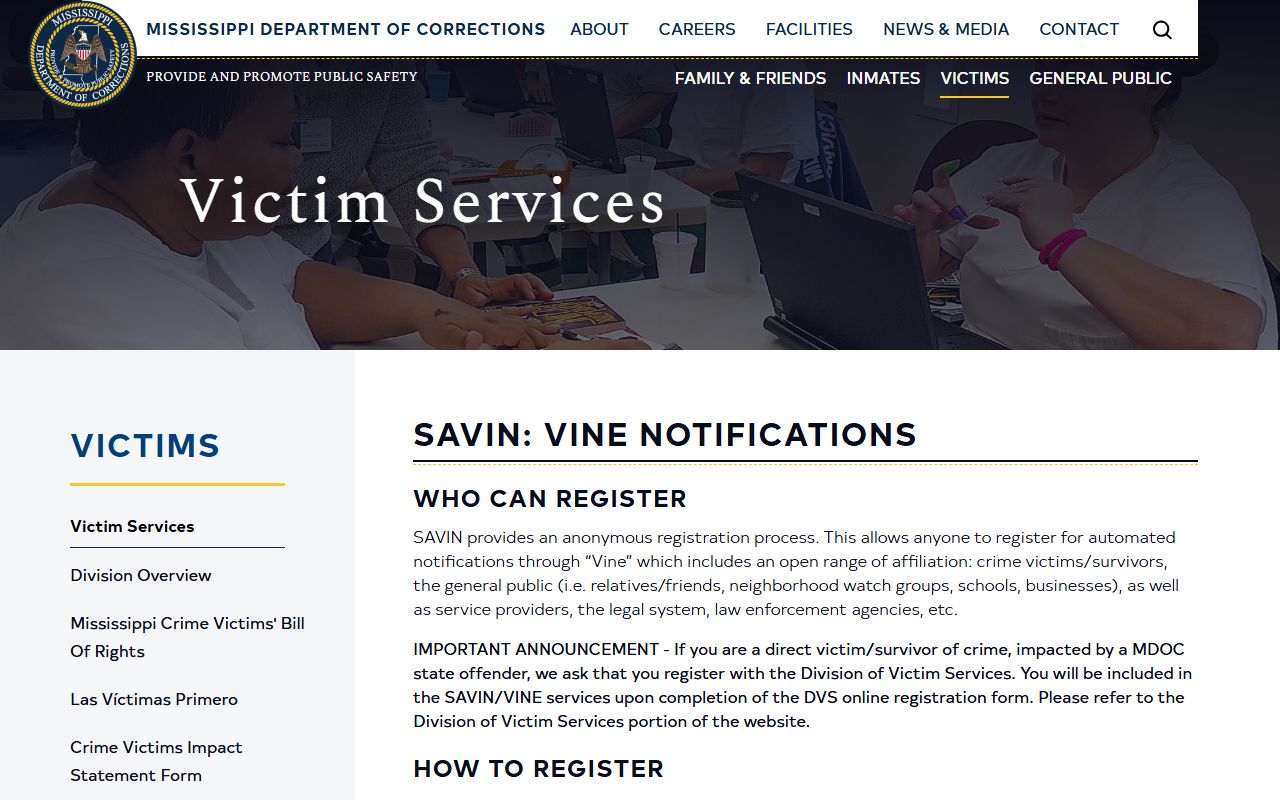
VINE lets a user follow a person's custody status and receive alerts if that status changes, which is useful when someone moves from the Wayne County jail to state custody. It is a custody-notification service, not a charge database, so it confirms where a person is held without listing the counts the court is weighing. For the actual charges, the case stays with the Circuit Clerk, the Justice Court, or the District Attorney.
Background Check Considerations
There is a real difference between a casual records lookup and a formal background check. Reading a Wayne County charge record for personal knowledge is one thing. Using it to decide on hiring, housing, credit, or insurance is another, and that use falls under the federal Fair Credit Reporting Act. A compliant background check runs through a regulated consumer reporting agency that follows accuracy, dispute, and notice rules. A free court index does not carry those safeguards, so charge entries it returns may be incomplete, out of date, or already expunged. Anyone making a legal decision about a person should rely on a proper FCRA process and verify charges with the originating court.
Important: This site is not a consumer reporting agency under the FCRA, and its information may not be used for credit, employment, tenant, insurance, or any other FCRA-regulated purpose.
Restricted Charge Records in Wayne County
Not every charge record is open to the public, and Wayne County withholds several categories by law. Youth Court charges are the clearest example. The county states that Youth Court is not open to the media or the public, and state law keeps juvenile records confidential except under narrow exceptions or a court order. Charges tied to a person under eighteen usually will not appear in any public search. Sealed and expunged charges also drop out of view, and a public lookup should not reveal their ordinary contents once an order is entered.
Other restrictions cover active and sensitive material. A charge that grew out of an ongoing investigation may be withheld while the case is live, and the same applies to sealed warrants behind a charge. Personal identifiers such as Social Security numbers, financial account data, and victim-sensitive details are redacted. When an online search turns up nothing, the fallback is to contact the court that holds the case directly: the Circuit Clerk at 601-735-1171 for felonies, the Justice Court at 601-735-3118 for misdemeanors and rural matters, or the Sheriff's Office at 601-735-3801 for booking and jail-docket questions, with a public-records request as the formal route for non-exempt entries.