
Criminal Court Records in Wayne County
A criminal court record is the case file the clerk opens the moment formal charges are filed. In Wayne County, felony case files are kept by the Circuit Clerk at the county courthouse. The file grows as the case moves, holding the indictment or information, bond orders, the arraignment, each plea, motions, hearing settings, the verdict or guilty plea, and the sentencing order. It can also hold restitution terms, fines and costs, probation conditions, revocation petitions, appeal notices, and any later expungement order. The clerk keeps these papers as the official record of the case.
Felony cases are tried in Circuit Court. Wayne County sits in the 10th Circuit Court District with Clarke, Lauderdale, and Kemper counties, and two judges hear its felony docket. Many cases pass through Justice Court first. Justice Court handles the early steps, such as the initial appearance, bond, and the affidavit or misdemeanor stage, before a felony moves to Circuit Court by indictment. Misdemeanor cases can end in Justice Court or a municipal court. The charges themselves are covered in more depth on the Wayne County arrest records and court charges page.
How to Search Wayne County Criminal Court Records
Public criminal case information for Circuit Court runs through Mississippi Electronic Courts, known as MEC and its public side PAMEC. One login lets the public view docket information, open documents, and pull case data in participating courts. Wayne County Circuit Court began mandatory attorney e-filing in May 2025, so its felony docket is now part of the statewide electronic system. A PAMEC account is needed for full access, and some documents carry per-page fees.
- Open the Mississippi Electronic Courts portal and choose the public access path.
- Register or log in through the PAMEC account page with a username and password.
- Search by defendant name or case number, then pick Wayne County Circuit Court.
- Open the case to read the docket entries, charges, plea, and disposition.
- Request a certified copy from the Circuit Clerk if the record is needed for legal use.
When an online search comes up empty, the Circuit Clerk is the fallback. Staff can confirm a case by phone at 601-735-1171, by email, or in person at the courthouse on Azalea Drive. Bring a name, a date range, and a case number if you have one. Older or non-digitized felony files may exist only in the clerk's paper minute books and must be pulled by hand.
Stages of a Wayne County Criminal Case
A felony case moves through set steps, and each one leaves a mark in the record. The docket reads as a timeline, so the entries show when a plea was taken, when a motion was filed, and when the judge handed down a sentence. Knowing the stages makes the file far easier to read.
Case flow: Charges Filed › Arraignment › Pretrial / Motions › Plea or Trial › Disposition › Sentencing
| Stage | What Happens |
|---|---|
| Arraignment | The court reads the charges and the defendant enters a plea of guilty or not guilty. Bond terms are often set or confirmed here. |
| Pretrial / Motions | Lawyers file motions, exchange discovery, and argue legal points. Hearings get set, and the case may be continued to a later date. |
| Plea or Trial | The case ends in a negotiated plea or a jury trial. A trial entry records the verdict and the votes of the court process. |
| Sentencing | After a guilty plea or verdict, the judge orders the punishment. The sentencing order lists prison time, probation, fines, and restitution. |
District Attorney Kassie Coleman and Felony Prosecution
The District Attorney represents the State in every Wayne County felony case. Kassie Coleman serves as District Attorney for Mississippi's 10th Circuit Court District, which covers Wayne, Clarke, Lauderdale, and Kemper counties. Her office screens cases, takes them to the grand jury, and prosecutes the charges in Circuit Court. The Wayne County district attorney page lists her term and the Meridian office that handles the district. The DA office, not the clerk, is the prosecutor contact for a pending felony.
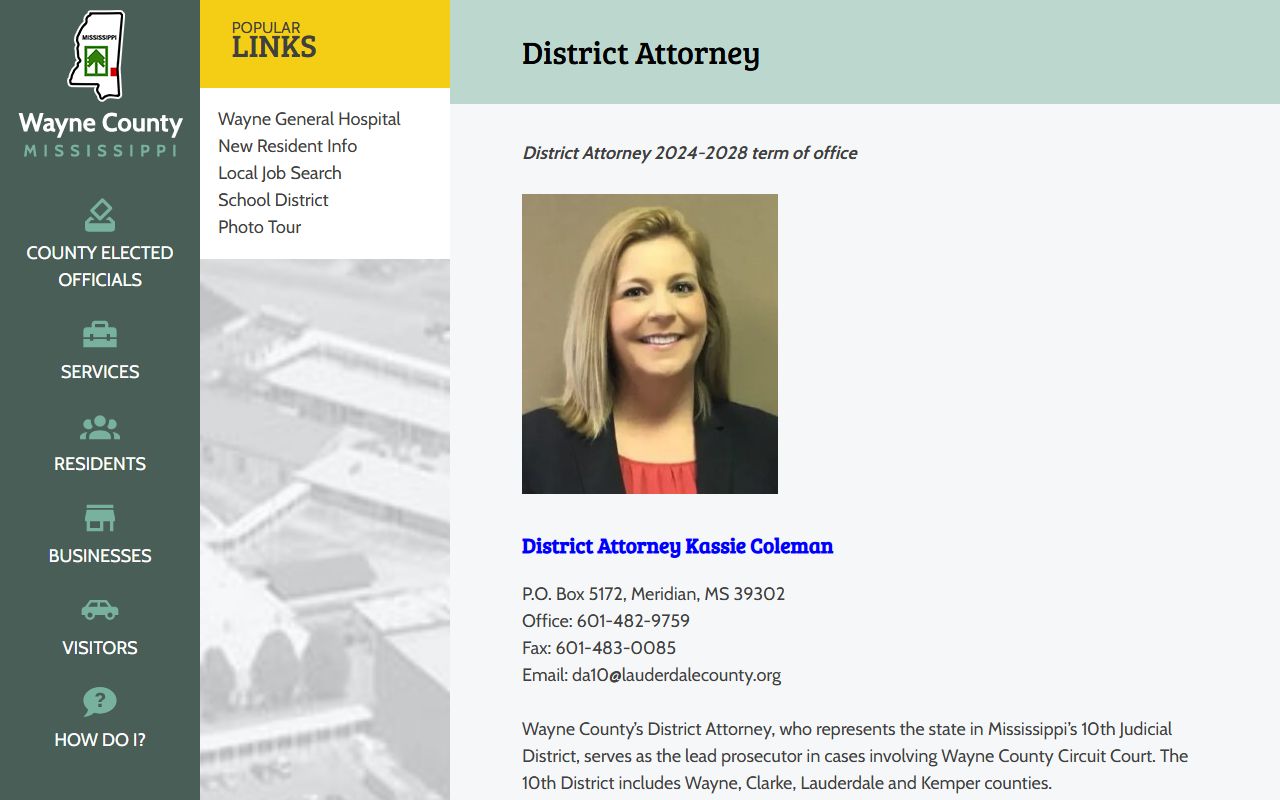
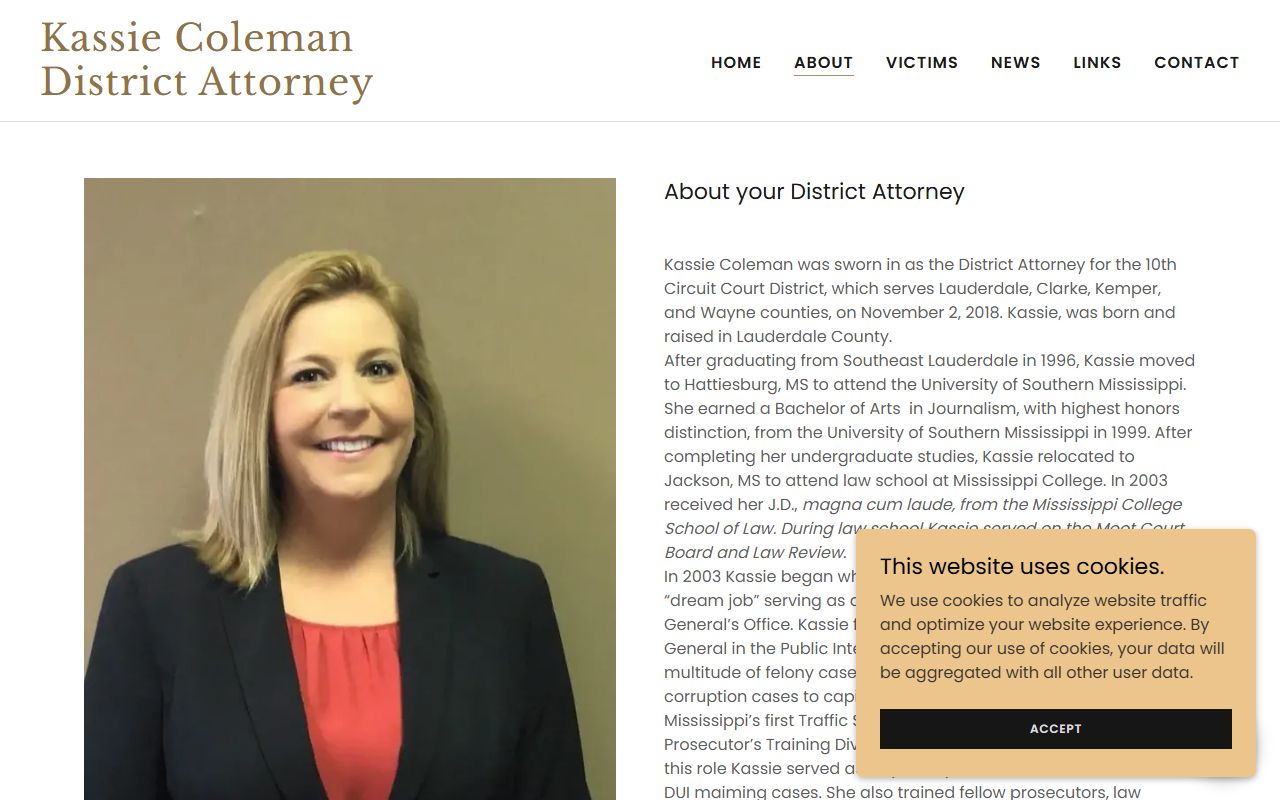
Coleman was sworn in on November 2, 2018, and her office runs a victim assistance program that updates felony victims on case status. Crime victims who want to follow a case should reach the DA office rather than the Circuit Clerk. The district keeps its own site with contact and background details. The 10th Circuit District office page outlines the counties served and how the office is organized.
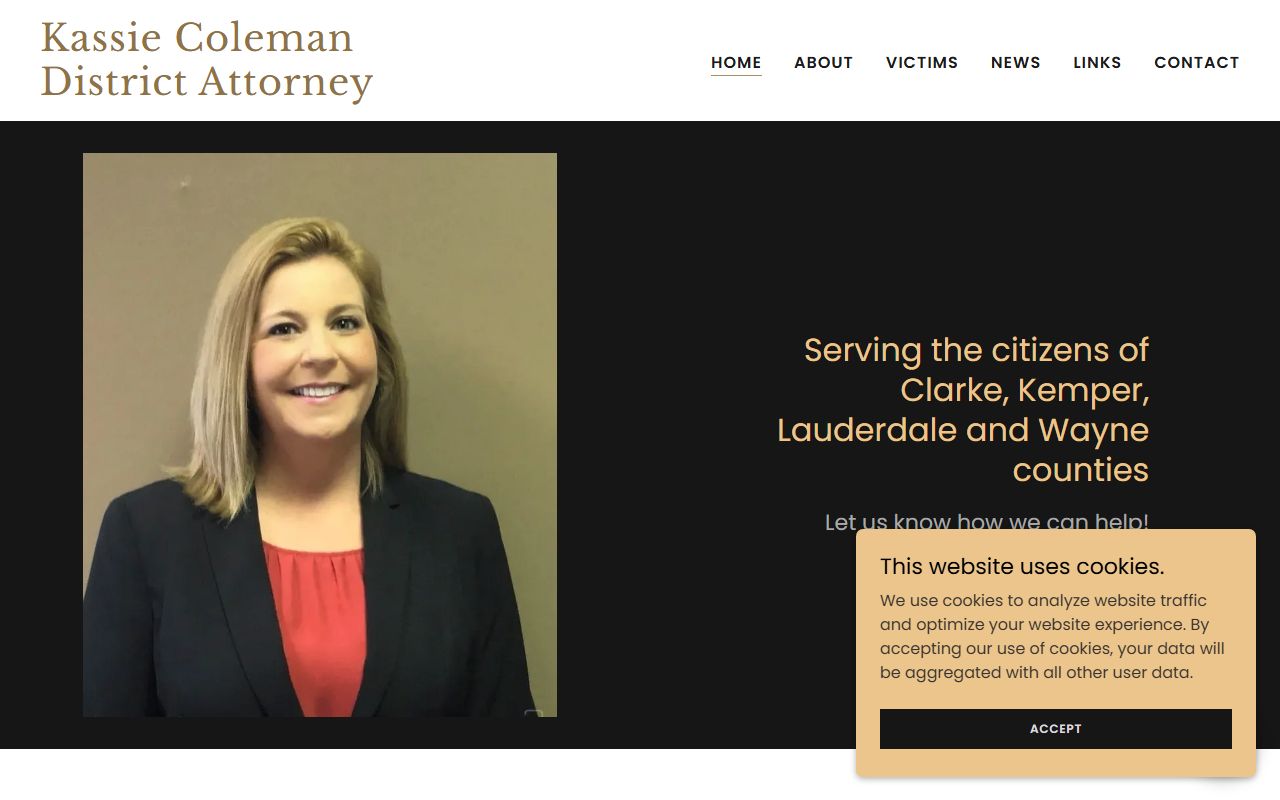
The grand jury decides whether the proof supports a felony indictment. If it does, the case is set for arraignment in Circuit Court, and the prosecutor carries it forward from there. The district attorney biography gives more on Coleman's role and the work of the office across the four counties.
What a Wayne County Criminal Court Record Shows
A criminal case file is built from many small fields, and each one answers a question about the case. Together they show who was charged, with what, how the person answered, and how the case closed. The table below walks through the core fields a Wayne County felony record holds.
| Field | What It Shows |
|---|---|
| Case Number | The MEC or PAMEC tracking number the Circuit Court assigns to the felony case. |
| Defendant | The name of the person charged, plus the State of Mississippi as the prosecuting party. |
| Charges | Each count, the statute cited, and the degree or class of the offense as filed. |
| Plea | The formal answer entered at arraignment, such as guilty, not guilty, or nolo contendere. |
| Disposition | The outcome of each count, such as convicted, dismissed, acquitted, or remanded. |
| Sentence | The punishment ordered, including prison time, probation, fines, costs, and restitution. |
Beyond these fields, the file lists the judge, the attorneys of record, every docket entry, and the financial items tied to the case. Items like Social Security numbers, account data, and victim-sensitive details are redacted by law before a record reaches the public.
Reading Wayne County Dispositions and Sentences
The disposition is the line that tells you how a count ended. A single case can hold more than one disposition when it carries several charges. Some terms in this part of the record are easy to misread, so a short glossary helps. The sentence follows a guilty finding and spells out the punishment in plain terms.
- Guilty
- The defendant pleaded guilty or was found guilty, which becomes a conviction.
- Not guilty
- The court or jury did not find guilt, and the count ends in acquittal.
- Dismissed
- The court dropped the count, with prejudice if it cannot be refiled or without if it can.
- Nolo contendere
- A no-contest plea that the court treats much like a guilty plea for sentencing.
- Probation
- Supervised release under court terms instead of, or after, time in custody.
A sentence may stack several parts. The judge can order prison time, suspend part of it, add probation, and set fines, court costs, and restitution to victims. A later revocation petition in the file means the State asked the court to cancel probation for a violation. Reading the most recent order is the only way to know a case's current status.
Charges vs. Convictions
Being charged is not the same as being convicted. A criminal court record can show charges that were later dropped, dismissed, or ended in acquittal. A charge is only an accusation, while a conviction is a proven result. Both stay in the public file, so a reader has to look at the disposition, not just the charge, to know what really happened.
| Charge | Conviction | |
|---|---|---|
| Stage | Accusation | Verdict or plea |
| Burden of Proof | Probable cause | Beyond reasonable doubt |
| Public Record | Yes | Yes |
Note: A dropped or dismissed charge still appears in the case file unless a court later grants an expungement that removes the public record.
Public Access to Wayne County Criminal Court Records
Mississippi treats most court records as open to the public. The Public Records Act lets people inspect records held by a public body unless another law shields them. For a Wayne County felony file, the first step is to name the court that made the record, which for felonies is the Circuit Court. From there, the Circuit Clerk and the PAMEC system are the main access points. The law does not override a sealed order, youth court secrecy, or a redaction required by statute.
Key Statutes:
Miss. Code § 25-61-1 - the Public Records Act policy, which makes public records open for inspection unless another law says otherwise.
Miss. Code § 25-61-5 - sets a seven-working-day window for a public body to produce a record or explain a delay in writing.
Miss. Code § 25-61-7 - lets the office charge fees calculated to cover the actual cost of search, copying, and mailing.
If a clerk denies a request, the Mississippi Ethics Commission handles complaints about public records. A felony file that is public can also be reviewed alongside the broader set of Wayne County court records kept by the clerks. Expect copy and certification fees, since Wayne County does not post a flat criminal-record price.
Sealed vs. Expunged Records
Sealing and expungement both limit public access, but they are not the same. A sealed record still exists and stays hidden from ordinary searches. An expunged record is removed or restricted so the law treats the event as if it never happened. Mississippi allows expungement only in set situations, and many serious offenses can never qualify.
| Sealed | Expunged | |
|---|---|---|
| Visibility | Hidden from public | Removed and treated as if it never existed |
| Law Enforcement | Limited access | Very limited |
| Eligibility | Youth court files and records sealed by court order under Miss. Code § 43-21-251 | Many non-convictions, dismissals, and qualifying offenses under Miss. Code § 99-19-71 |
An expungement is filed in the court that handled the case, often the Circuit Court for a felony. The person should gather the arrest date, charge, case number, disposition, and proof that fines and costs were paid. A judge may hold a hearing before granting the order. Youth records are sealed under Miss. Code § 43-21-251, while adult expungements run through Miss. Code § 99-19-71, which sets the offenses and waiting periods that qualify.
Restricted Criminal Court Records in Wayne County
Not every criminal record is open. Some files are closed by law, and others hold parts that a clerk must withhold. Youth Court cases are the clearest example. Wayne County's Youth Court is not open to the media or the public, and its records are sealed under state law. Juvenile delinquency, abuse and neglect, and termination-of-parental-rights matters stay confidential except under narrow exceptions or a court order.
Several other categories carry limits worth knowing before a search:
- Sealed and expunged adult cases, which should not show ordinary contents to the public.
- Mental-health and substance-abuse commitment files handled in Chancery Court.
- Personal identifiers such as Social Security numbers and financial account data.
- Active investigative material that law enforcement has not released.
- Victim-sensitive details that statute requires the clerk to redact.
This site is a private resource and is not a consumer reporting agency under the Fair Credit Reporting Act. Records found here cannot be used for credit, employment, housing, or other FCRA-regulated decisions. A felony with an active arrest order is checked and resolved through the sheriff and the issuing court. Note: A criminal court file can change after a hearing, so always read the latest docket entry before relying on a record.